Napoleon Bonaparte
Listening station 005
Ready to listen
The recording could not be started. Please try again.
Audio transcript
Napoleon Bonaparte
French emperor – general –
power-hungry conqueror
Napoleon Bonaparte was born in Corsica in 1769 into a minor noble family. During the French Revolution, he quickly proved to be a military talent.
As a power-hungry conqueror, the countries of Europe trembled before him. His wars claimed more than a million lives.
Napoleon elevated Bavaria to a kingdom in 1806. In return, King Maximilian of Bavaria joined the Confederation of the Rhine founded by the French emperor. Bavarian troops now had to fight for Napoleon. Tens of thousands of lives were lost in the process.
Now for our Vohburg story:
When Austria declared war on the French Emperor in 1809, Bavaria once again became the scene of fighting.
Napoleon was just 40 years old.
During this time, Europe’s most powerful man stayed on the castle hill in Vohburg. The castle, built in 1721, was the former residence of the district administrator and judge.
Franz Xaver Lettner was pastor in Vohburg from 1790 -1815 and made the following notes:
On 19 April, at about 2 in the afternoon, Napoleon rode from Ingolstadt and arrived at the brickworks north of the Danube. From the Jura heights near Dünzing, he overlooked the area south of the Danube in order to gain a strategic overview. Back at the brickworks, he is served by Frau Erbesmayrin, a widow and local healer, with black bread soup in an earthenware bowl and half a litre of beer in a glass tankard. He eats and drinks.
Finally, he crosses the Danube and enters the market town of Vohburg. In front of today's Fertl building, he sits down in a wooden chair, views the passing troops and has maps spread out before him. At about 6 o'clock in the evening he goes to the castle in Vohburg, where candlesticks and candles from the parish church have been placed along the stairs leading up to the emperor's room. It is said that: "He was poorly dressed".
It will not be a restful evening for him. He consults with his entourage on planned troop movements. A constant coming and going can be observed. He even met with the Bavarian Crown Prince Louis. Now and then Napoleon reaches into his silver tobacco box. In between, he lies down, uniform and all, and falls into a deep sleep for 15 to 20 minutes, from which he awakens completely physically and mentally refreshed.
The next day, he leaves Vohburg at 8 o’clock to personally lead the planned combat operations in the Abensberg – Siegenburg – Biburg area.
The cost of billeting his troops and the plundering of natural resources was never reimbursed. The local inhabitants suffered greatly as a result. French infantry ranged from house to house, demanding money, drinking beer, wine, brandy, and taking whatever they wanted from the local stores without paying a penny. Once they had ransacked a house, the inhabitants had to leave everything in a mess, otherwise it would be ransacked again.
The original wooden "Napoleon chair" is very well preserved and on display here. Back then, Peter Schwaiger ran a bakery in what is now the Fertl building. He also made wooden furniture and utensils, such as tables, baking troughs and the Napoleon chair.
Napoleon died on 5 May 1821, a prisoner on the island of St. Helena.
Exhibit number or search term
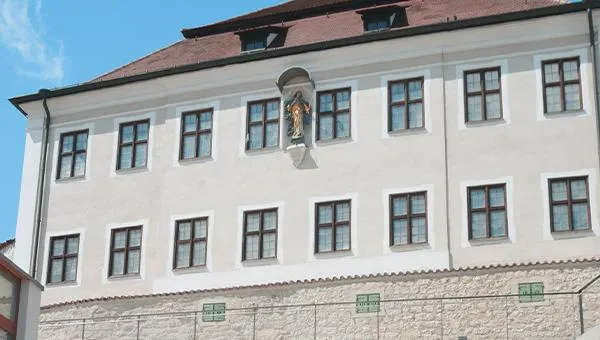
An original museum recording about Napoleon’s stay in Vohburg and the surviving Napoleon chair.
Image credits: Museum Vohburg im Pflegerschloss · Bildquelle: Museum Vohburg